
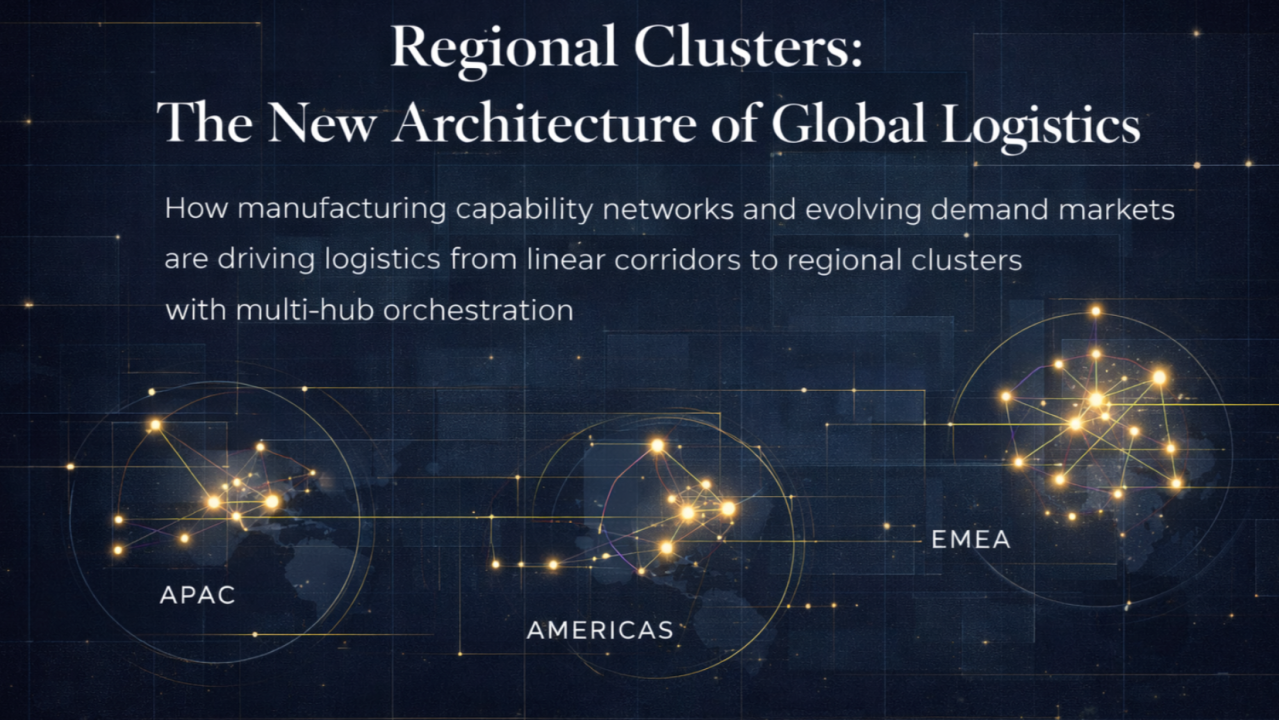
How manufacturing capability networks and evolving demand markets are driving logistics from linear corridors to regional clusters with multi-hub orchestration
For two decades, global logistics optimized around long-haul corridors. Asia to the West via ocean freight. Hub-and-spoke operations radiating from China. Linear flows, point-to-point efficiency, and cost minimization as the guiding principle.
That model is being rewritten.
Logistics is reorganizing around regional clusters: APAC, the Americas, the Middle East, and Europe. Each cluster operates with multiple hubs, distributed capabilities, and selective inter-cluster flows. The drivers are risk diversification after pandemic disruptions, regional demand growth, and compliance complexity as tariffs, rules of origin, and ESG mandates reshape routing decisions.
This is not simply about adding hubs. Mexico now accounts for $840 billion in bilateral trade with the United States, surpassing China as the top trading partner. Vietnam attracted $38 billion in foreign direct investment in 2024. Gulf states have committed over $100 billion to logistics infrastructure under national diversification plans.
But geographic diversification alone does not create resilience. The real shift is architectural. Logistics is moving from optimizing global corridors to orchestrating regional clusters. And cluster architecture is not static—it is shaped by manufacturing strategy evolution toward capability-flow networks and ongoing shifts in demand markets.
Sattaris’s cross-border operations practice reveals a consistent pattern. Firms that design clusters for today’s corridors struggle when manufacturing and demand evolve. Those that embed node specialization, flow intelligence, and reconfiguration speed into cluster architecture gain operational advantage that compounds over time.
The Emerging Clusters
Four regional clusters are taking shape, each with distinct characteristics.
The APAC Cluster spans China, Vietnam, India, Indonesia, and Singapore as connector. Driven by China+1 diversification and growing intra-Asia trade, Vietnam’s industrial output contributed 8.3% to GDP growth in 2024, while India targets reducing logistics costs from 13% of GDP to 8% by 2030 through infrastructure reforms.
The Americas Cluster integrates the United States, Mexico, and Canada, with Panama as connector. Nearshoring has accelerated under USMCA, with Mexico capturing manufacturing in automotive, electronics, and machinery. Panama handles roughly 6% of global maritime trade.
The Middle East Cluster includes the UAE, Saudi Arabia, and Oman. The UAE logistics market is projected to reach $27.5 billion by 2029. Saudi Arabia has invested over $100 billion in ports, rail, and logistics parks under Vision 2030.
The Europe Cluster spans core EU economies, Eastern European manufacturing centers in Poland and the Czech Republic, and Turkey as bridge to Asia, pursuing strategic autonomy in supply chains.
Regional clusters reduce long-haul dependency, shorten lead times, and create multi-hub resilience. But clusters alone do not create advantage. The architecture of those clusters—shaped by how firms manufacture and where demand is heading—determines competitive outcomes.
How Manufacturing and Demand Shape Cluster Architecture
Manufacturing strategy has shifted from cost hubs to capability-flow networks. Production nodes are specialized by capability: India for regulated quality assurance, Vietnam for speed-to-volume electronics, Mexico for proximity to U.S. markets, Indonesia for energy-intensive processing. This evolution, combined with shifting demand patterns, creates three critical design imperatives for logistics clusters.
Node Specialization in Distribution
Logistics cannot treat all hubs within a cluster as interchangeable. Routing must align with manufacturing capability and demand requirements.
India manufactures regulated medical devices and pharmaceuticals, requiring compliance-smart corridors with FDA and CE Mark routing and pre-approved customs brokers. Vietnam produces high-volume electronics, needing high-velocity lanes for fast ocean freight to U.S. West Coast and rapid intra-APAC fulfillment. Mexico manufactures automotive components, demanding cross-border fluidity with USMCA-compliant lanes and just-in-time delivery.
Simultaneously, regional demand is reshaping priorities. The APAC middle class is expanding, and serving APAC customers from APAC hubs shortens lead times. The Americas follow similar patterns. Mexico-U.S. trade volume reflects proximity and speed advantages of serving North American demand from regional infrastructure.
When manufacturing nodes specialize by capability and demand concentrates regionally, logistics clusters must specialize routing accordingly—designing distribution corridors around production capabilities and customer proximity, not just the lowest freight rate.
Flow Intelligence and Distributed Inventory
Manufacturing increasingly designs products with modularity, enabling sourcing from multiple nodes depending on tariff environments and capacity constraints. Customer expectations for speed have intensified. Amazon delivered 6.3 billion parcels in the U.S. in 2024, making same-day and next-day delivery baseline expectations.
This dual pressure requires dynamic routing and distributed inventory. A product might qualify for shipment from Vietnam under RCEP, from India under GSP provisions, or from Mexico under USMCA, depending on destination and tariff landscape. Logistics systems must calculate optimal routing in real time based on tariff rates, rules of origin, and hub capacity.
Products are pre-positioned in regional hubs based on demand forecasting, reducing long-haul replenishment dependency. Cluster connectors like the Middle East and Panama serve as strategic stock points for fast inter-cluster rebalancing when demand spikes.
Our founder’s experience scaling global operations across the U.S. and India taught this directly: multi-geography networks fail when logistics partnerships lock firms into static routes while manufacturing strategies and demand patterns demand dynamic flows.
Reconfiguration Speed and Compliance Embedding
Manufacturing can pivot production between nodes in weeks. Logistics must reroute just as quickly, requiring cluster architecture designed for reconfiguration: multiple carriers per lane, short-term warehouse agreements, multi-modal options.
Simultaneously, compliance and ESG pressure is rising. Eighty-one percent of companies factor ESG into supplier selection. Green shipping corridors are emerging with firms like Maersk deploying methanol-fueled vessels. Regulatory complexity is growing through supply chain due diligence laws.
Logistics clusters must embed compliance into corridor design from the start. Green routes are being developed with lower-emission vessels. Compliance verification increasingly happens at cluster connector points like Dubai, which screens shipments before forwarding to final destinations. Panama offers customs pre-clearance reducing delays.
For medical devices manufactured in India, compliance-embedded routing means pre-approved lanes with established customs relationships, ensuring documentation aligns with regulatory requirements before shipping, reducing risk and avoiding costly destination-port delays.
Manufacturing’s flow-first design and rising compliance mandates require logistics built for reconfiguration speed with compliance embedded, not bolted on.
Implications for Leaders
The shift from corridors to clusters is underway. The question for operations leaders is whether logistics architecture is designed for regional clusters or still optimized for global corridors.
Design clusters for manufacturing flexibility, not just geography. Adding hubs does not constitute cluster strategy. The test is whether logistics can reroute as quickly as manufacturing can pivot. If production shifts take four weeks but logistics rerouting takes four months, manufacturing investment delivers no advantage.
Embed compliance and tariffs into cluster design. Rules of origin and ESG requirements should not be separate workstreams. Tariff-smart routing and clean corridors must be embedded into logistics systems from day one, with platforms calculating optimal routing based on trade rules automatically.
Optimize for intra-cluster speed, not just inter-cluster cost. Regional customers increasingly expect service from regional hubs with lead times in days, not weeks. This requires prioritizing fast regional distribution while maintaining cost discipline.
Build governance for orchestration, not just footprint. Multi-hub footprints without orchestration capability create complexity without resilience. Decision rights must be clear: who decides when to reroute shipments when capacity tightens, and how quickly? Coordination rhythms matter: weekly cross-hub planning, monthly system reviews, quarterly strategic adjustments. Firms that empower the middle layer with authority, tools, and clarity to make trade-offs in real time treat logistics as orchestration, not just footprint.
Sattaris helps clients design cluster architecture that enables manufacturing flexibility and meets demand requirements, building the node specialization, flow intelligence, and governance muscle that turn multi-hub footprints into orchestrated networks capable of responding to evolving manufacturing strategies and shifting demand markets.
Logistics is shifting from global corridors to regional clusters. Cluster architecture is shaped by manufacturing capability networks and demand market evolution. The firms that win design clusters where node specialization, flow intelligence, and compliance are embedded from the beginning.
As manufacturing strategies and demand markets continue evolving, logistics cluster architecture will adapt with them. The advantage goes to firms that treat logistics as a dynamic system, not a fixed network locked into legacy partnerships and static routes.
When evaluating logistics footprint today, the question is whether the approach optimizes global corridors or orchestrates regional clusters. And as manufacturing strategy evolves, can logistics architecture evolve with it?